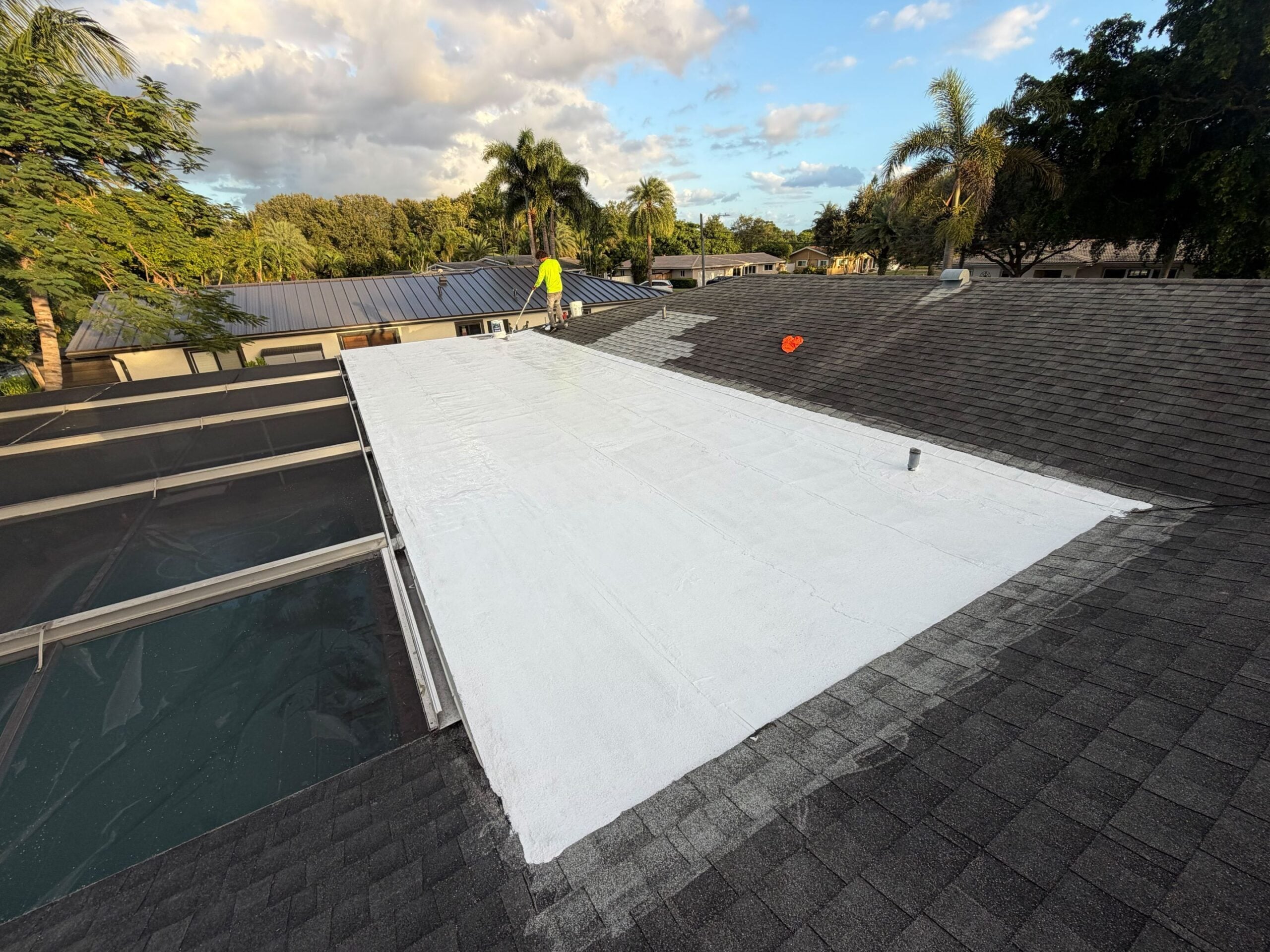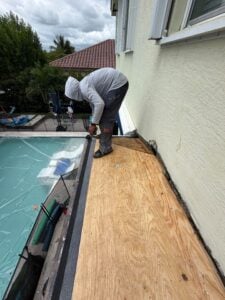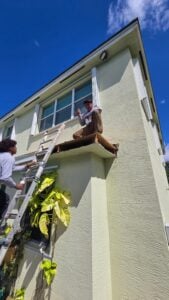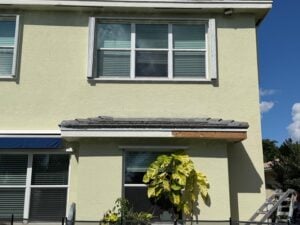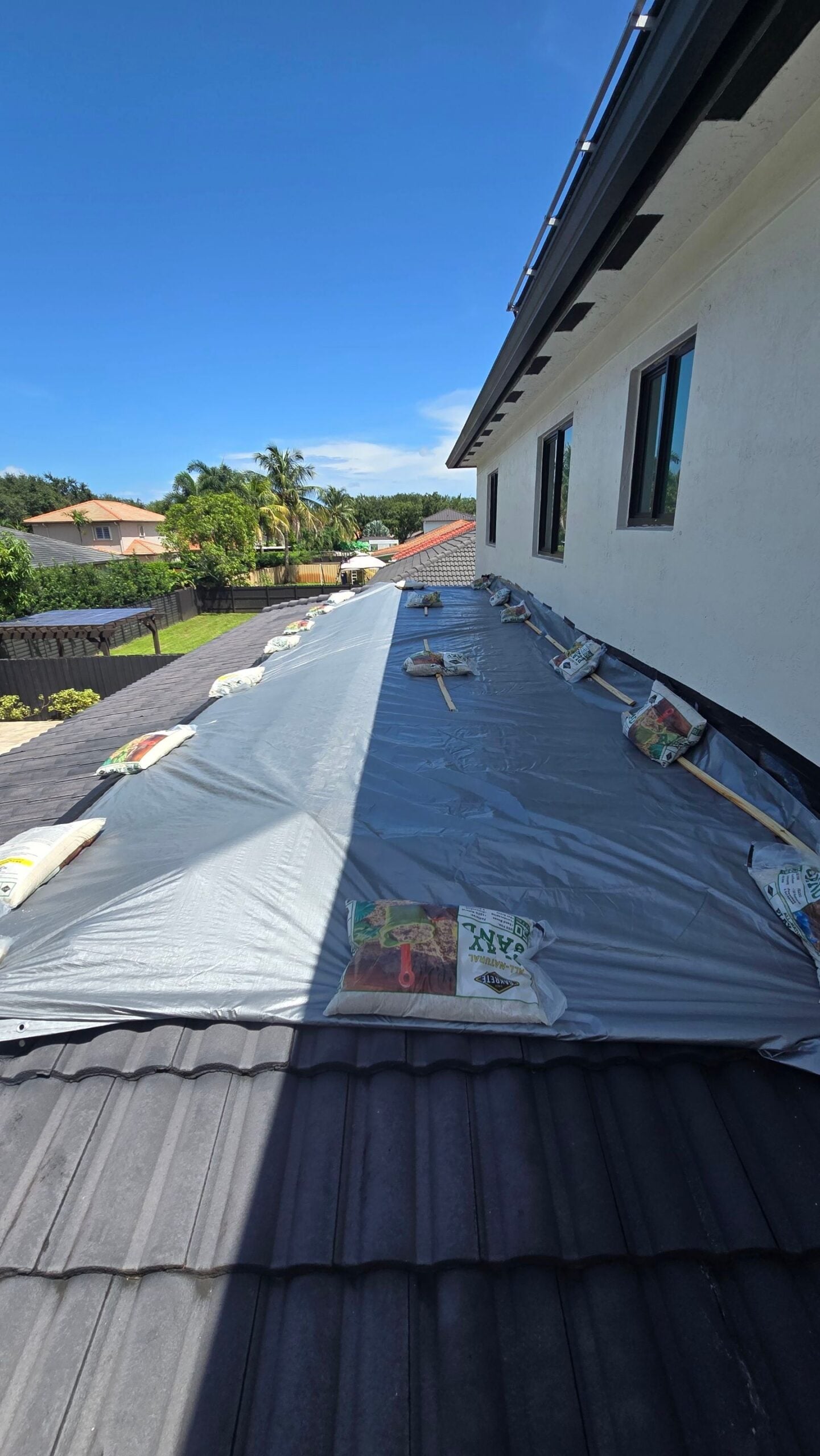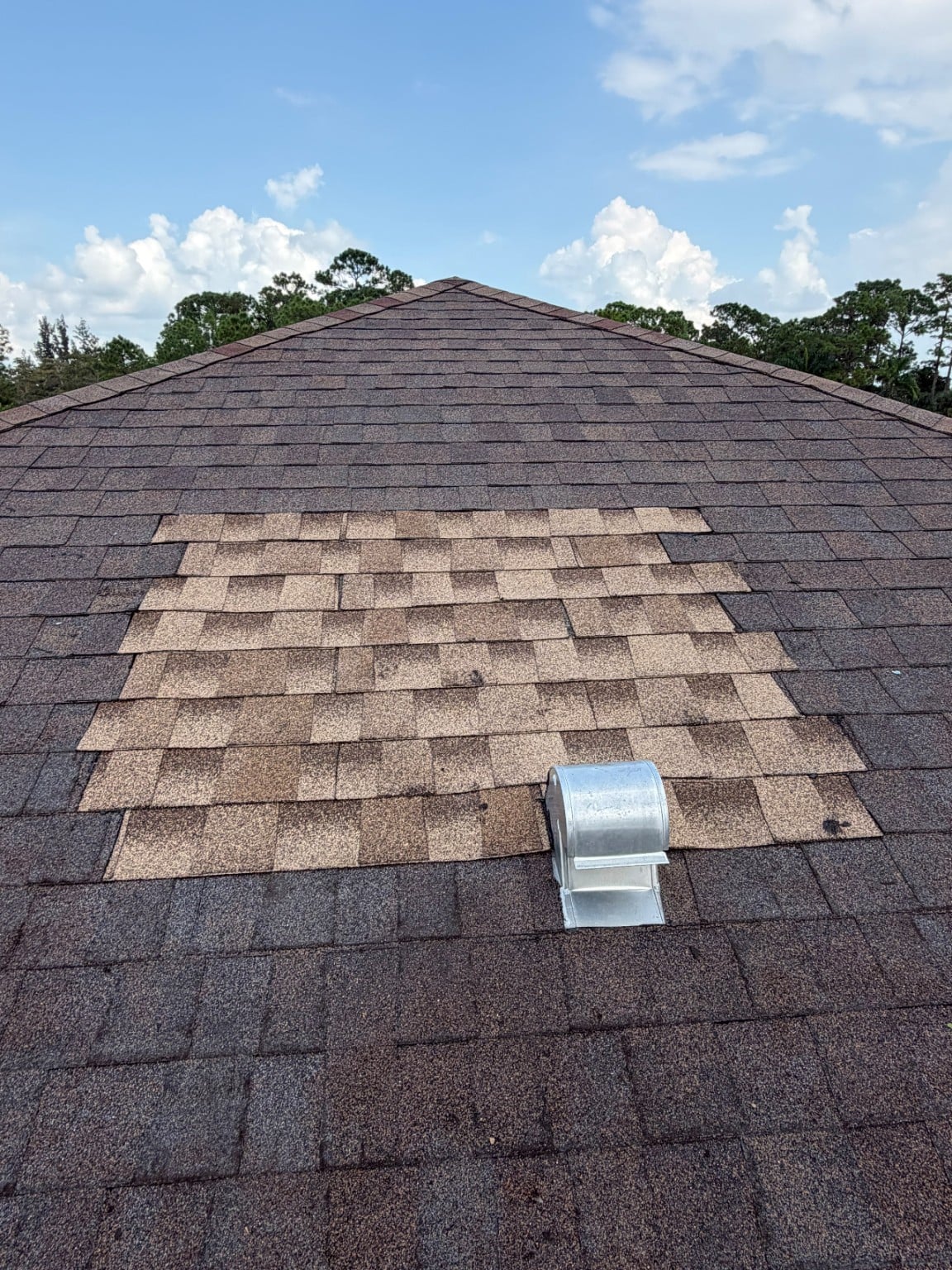
This Heritage Farms shingle roof repair involved a difficult-to-locate leak on an eight-year-old asphalt shingle roof in the Heritage Farms equestrian community near Lake Worth and Wellington, Florida. Because the home has a spray-foam-insulated attic, water was moving through and being held by the foam before dripping into the attic. The first suspected source was the nearby kitchen hood gooseneck vent, but controlled hose testing showed that the leak was actually farther up the roof.
Quick Summary
BLU Roofing diagnosed and repaired a field leak on an eight-year-old shingle roof in Heritage Farms. The crew tested the gooseneck vent first, then worked upward row by row until the leak was isolated approximately five feet above and to the left of the vent. The repair included removing shingles and old 30-pound felt, installing Polyglass Polystick TU Plus, tying it into the existing system with Polyglass PG 500 and APOC 470 reinforcing fabric, reinstalling GAF HDZ Shakewood shingles, resealing the gooseneck vent, and completing a final 15 to 20-plus-minute hose test.
Table of Contents
- Project Facts
- Why the Leak Was Hard to Find
- Controlled Hose Testing
- Repairing the Shingle Roof
- Final Testing and Documentation
- Customer Feedback
Project Facts
| Community | Heritage Farms, an equestrian community near Lake Worth and Wellington, Florida 33449 |
| Property | Single-family home |
| Roof system | Eight-year-old asphalt shingle roof from new construction |
| Reason for service | Dripping noise and water entering the attic during heavy rain |
| Initial suspected source | Kitchen hood gooseneck vent |
| Confirmed leak area | Approximately five feet above and to the left of the gooseneck vent, in the shingle field |
| Underlayment repair | Polyglass Polystick TU Plus tied into the existing system with Polyglass PG 500 and APOC 470 reinforcing fabric |
| Shingles | GAF HDZ shingles in a Shakewood color selected to match the existing roof as closely as possible |
| Testing | Initial and final controlled hose tests, with the final test lasting approximately 15 to 20 minutes or longer |
| Timeline | Half-day repair completed in the morning by Peter and his foreman |
Why This Leak Was Hard to Find
The homeowner first noticed a dripping noise in the attic and initially suspected the kitchen hood gooseneck vent. That was a reasonable assumption because the vent was visible near the area where the sound appeared to be coming from. A first hose test around the vent did not produce water inside the attic.
The situation became more complicated when the roof was inspected from inside. This home has a spray-foam-insulated attic, so the foam covers the underside of the roof deck and prevents the normal visual inspection that is possible in an unfinished or conventionally insulated attic. The foam was also holding water and allowing it to travel before releasing it as a drip. That meant the point where water appeared inside was not necessarily the point where water entered the roof.
There was also buckling in portions of the plywood roof deck where expanding spray foam appears to have pushed through seams between decking panels. The buckling was observed in multiple areas of the roof and was not corrected as part of this localized leak repair. It was documented as an existing roof condition, not identified as a confirmed cause of this particular leak.
Controlled Hose Testing Isolating the Leak
Because the roof could not be fully evaluated from below, the diagnosis required a controlled hose test with one person on the roof and one person in the attic. The test began at the gooseneck vent. The crew worked upward row by row, applying water to a controlled area and then checking the attic for a response.
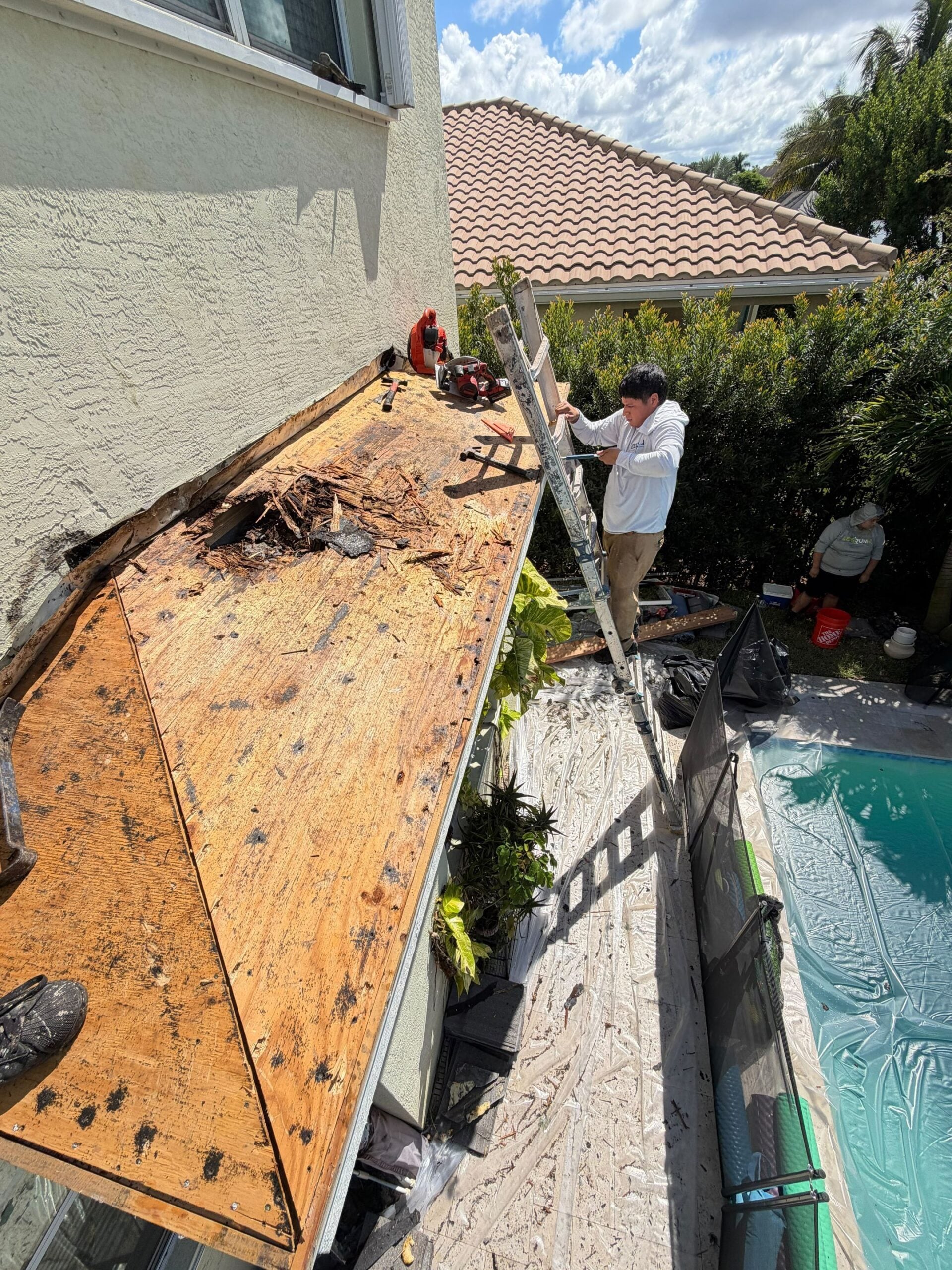
That process isolated the leak approximately five feet above and to the left of the gooseneck vent. The water was entering through the shingle field rather than the vent itself. There was an exposed nail in the area, sometimes called a shiner in roofing, along with wet plywood below the repair area. The plywood was damp, but it was not rotted or deteriorated because the leak was caught quickly.
The homeowner had previously experienced another leak on this relatively young roof. This project illustrates why a roof leak should be diagnosed instead of automatically repairing the nearest penetration. The closest vent may be dry while water is entering higher on the roof and traveling through the assembly before appearing inside.
Repairing the Shingle Roof
The repair area was opened from the shingle surface down to the roof deck. The shingles were removed, along with the existing 30-pound roofing felt. The exposed deck was inspected, and the damp plywood was found to be serviceable. No plywood replacement was necessary.
New Polyglass Polystick TU Plus self-adhered underlayment was installed over the repair area. The new material was tied into the existing underlayment system with Polyglass PG 500 modified cement and four-inch APOC 470 asphalt-saturated reinforcing fabric. PG 500 is a trowel-grade bonding and waterproofing material that Polyglass identifies for flashing details and membrane repairs. APOC 470 is an asphalt-saturated cotton reinforcing fabric used to reinforce roof repair areas.
The repair area was extended down to the top of the gooseneck vent so the surrounding transition could be addressed as part of the work. The top of the gooseneck vent flashing was also resealed and tied into the membrane repair with PG 500 and reinforcing fabric. This did not mean the vent was the confirmed source of the leak. It was included because the repair area reached the vent and the surrounding detail needed to be properly closed back up.
After the underlayment work was completed, the crew reinstalled the shingles using GAF HDZ shingles in a Shakewood color selected to match the existing roof as closely as possible. The repair was tied into the surrounding shingle field so the roof could be closed and tested before the crew left.
Final Testing and Documentation
After the initial repair, the crew performed another hose test. Water had stopped in three of the four areas that had been dripping, but one area continued to release a small amount of water. Because the spray foam attic was holding water, a small section of foam had to be removed to release the trapped water and expose the remaining active area.
The crew then tested directly above that location, found the last remaining leak point, repaired it, and performed another hose test. The final test lasted approximately 15 to 20 minutes or longer, long enough to allow water to reach the repaired area and confirm the result. No further water entry was observed after the final repair.
Testing roof repairs before leaving is good practice when the roof area can be safely tested. It gives the contractor an opportunity to find a remaining leak before the job is closed out and can help reduce the chance of an unnecessary callback. In this case, the additional test found a small amount of water that had remained trapped in the spray foam, allowing the crew to correct the final issue the same morning.
Peter and his foreman completed the repair in approximately half a day. The work was finished before the afternoon showers arrived. Before, during, and after photos were recorded in a CompanyCam report, and the work area was cleaned carefully before the crew left. No HOA approval or permit was required for this localized repair.
Customer Feedback
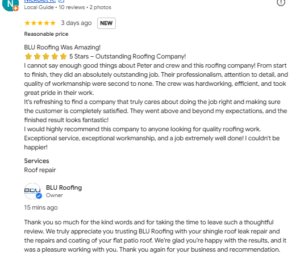
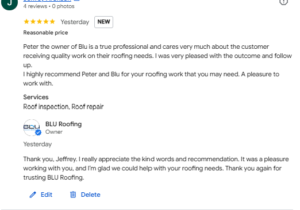
The homeowner supplied the following review after the repair:
A difficult-to-trace leak does not always come from the closest roof penetration. Spray foam, roof pitch, decking conditions, and water migration can all affect where a leak appears inside a home. A controlled inspection and testing process can help identify the actual entry point before a repair is recommended.
Written By: Peter Menke
Peter Menke is the owner of BLU Roofing and has been serving the South Florida roofing industry for over 6 years. He founded BLU Roofing to provide homeowners with transparent, accurate information grounded in real Florida roofing conditions and building practices. License #CCC1337285.
BLU Roofing provides roof inspections, repairs, restoration, and replacement for shingle, tile, metal, and flat or low-slope roof systems across Palm Beach, Martin, and Broward Counties.