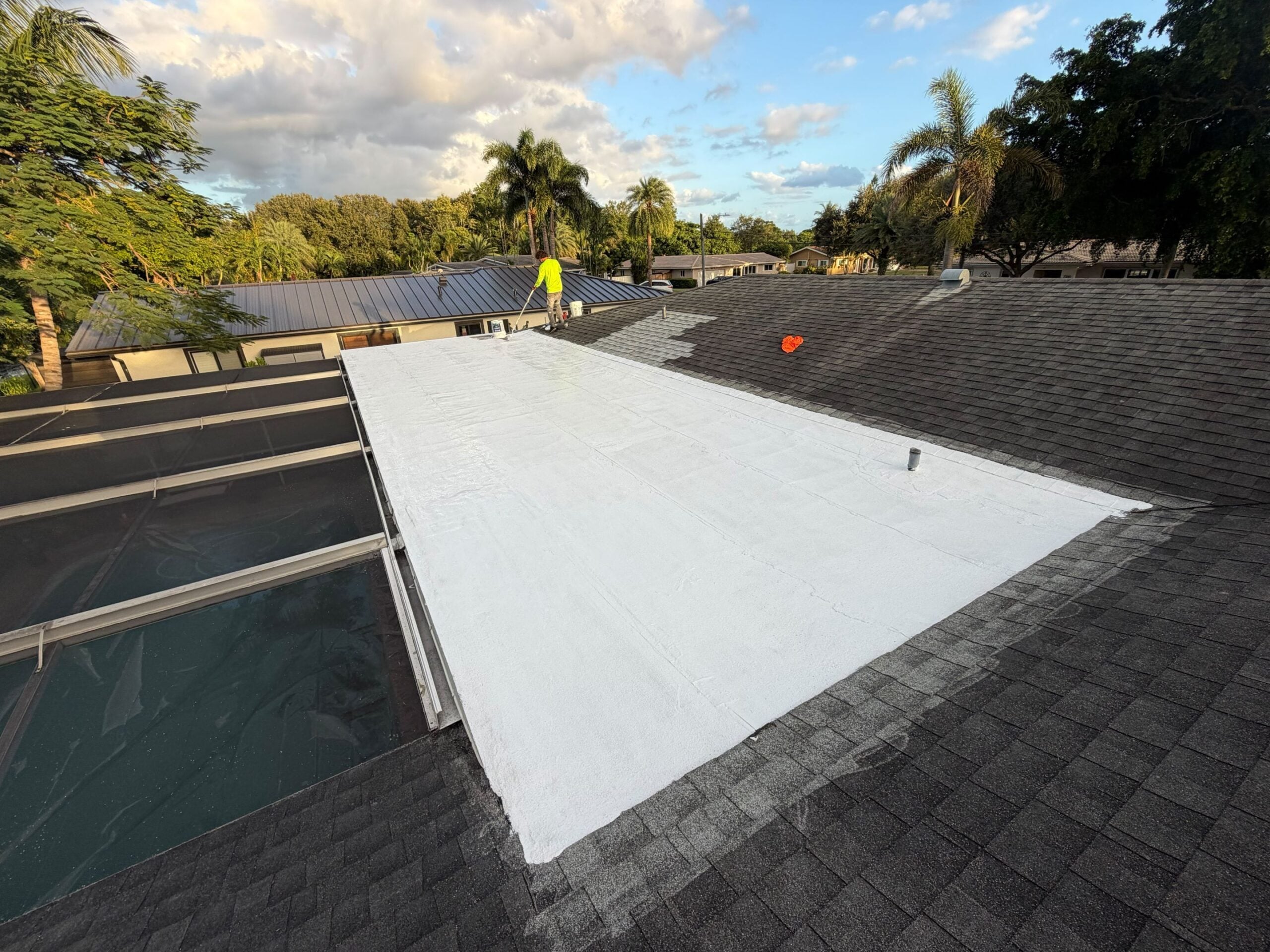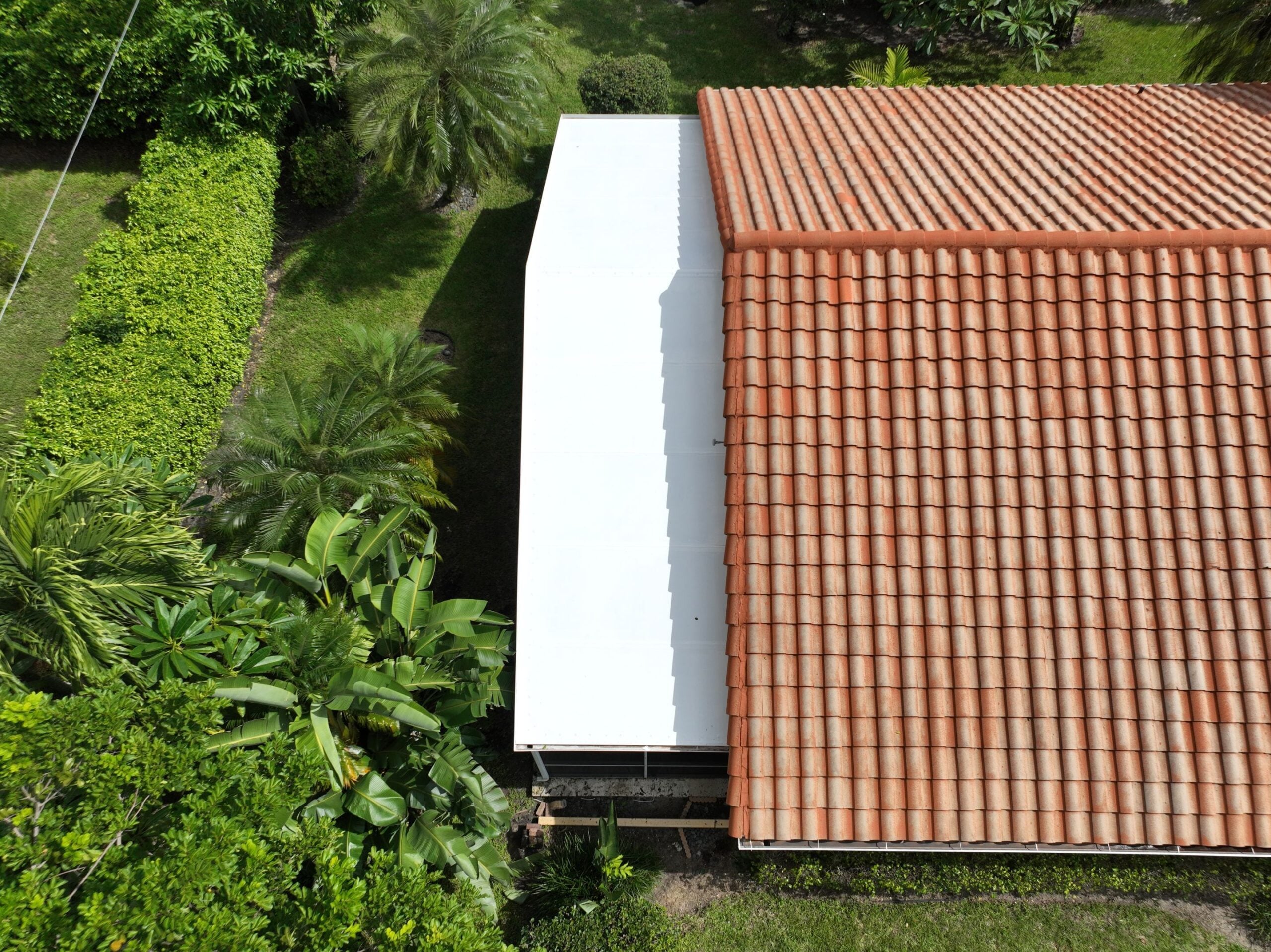
A ceiling stain does not always point to the roof detail that looks most suspicious from the outside. On this project in Andalucia, a gated community in western Lake Worth near Wellington, a homeowner who was preparing to sell the home was considering a repair proposal of nearly $2,000 for the wrong area. The original estimate focused on a dryer vent. A real estate agent partner referred the homeowner to BLU Roofing for a second opinion, and a methodical inspection showed that the actual leak source was about five feet away at a different roof penetration.
Quick Summary
BLU Roofing completed an Andalucia Lake Worth roof leak repair on a two-story tile roof after a real estate agent referred the homeowner for a second opinion. Attic evidence did not support the original dryer-vent diagnosis. We inspected the ceiling-stain location, attic, roof penetrations, and vent pipe, then used controlled hose testing to isolate a small gap in the lip of a lead pipe boot. After drying and sealing the precise opening, the leak repair was completed the same day for a $500 service call and repair. More than six weeks later, after substantial South Florida rain, the repair was still holding.
Watch the controlled roof leak diagnosis that identified the exact source before any repair was made.
Project Facts
| Community | Andalucia, western Lake Worth, FL, near Wellington |
| ZIP Code | 33467 |
| Home Type | Two-story townhome with a concrete tile roof |
| Initial Concern | Ceiling water stain while the property was being prepared for sale |
| Prior Proposal | Nearly $2,000 to repair at the dryer-vent area |
| Actual Leak Source | Small gap at the lip of a lead pipe boot, approximately five feet from the initially suspected dryer vent |
| Diagnostic Method | Interior stain review, attic inspection, exterior inspection, controlled hose testing, and vent-pipe testing |
| Repair Performed | Dried and sealed the exact opening at the lead pipe boot lip |
| Outcome | Completed the same day, with no further leak after more than six weeks of South Florida rain |
Table of Contents
- Why a Second Opinion Made Sense
- The Attic Evidence Did Not Match the Dryer Vent
- Controlled Testing, One Possibility at a Time
- The Actual Source: A Small Gap at the Lead Pipe Boot
- Why Roof Leak Diagnosis Matters More Than Guessing
- The Repair and the Result
Why a Second Opinion Made Sense
This home, located in the Andalucia community in western Lake Worth, was under contract preparation for sale. The homeowner had noticed water staining on the ceiling and needed a reliable answer before moving forward. A previous roofing company had identified the dryer vent as the suspected leak source and proposed a repair of nearly $2,000. The homeowner had questions about that diagnosis, and a real estate agent who works with BLU Roofing referred us for a second opinion.
We are not in a position to say what testing another company did or did not perform. What we can say is that the visible ceiling stain, the attic evidence, and the dryer-vent location did not line up during our inspection. A correct repair starts with a correct diagnosis. When the source is uncertain, replacing the first component that appears suspicious can be expensive and still leave the homeowner with the same leak.
For a homeowner preparing to sell, that distinction matters even more. The goal is not simply to produce an invoice showing that a repair was performed. The goal is to identify the actual source of the water intrusion, correct it, and have confidence that the repair will hold during the next rainfall.
The Attic Evidence Did Not Match the Dryer Vent
We started where a proper leak inspection should start: inside the home and inside the attic. The stain location is a clue, but it is not a map. Water can travel along the underside of roof decking, along framing members, down plumbing pipes, or along other building components before it becomes visible on a ceiling.
At the dryer-vent area, we did not find evidence of active or prior water intrusion that correlated with the ceiling staining. About five feet away, however, we found moisture around a separate vent pipe penetration. That gave us the right general area, but it did not prove the cause.

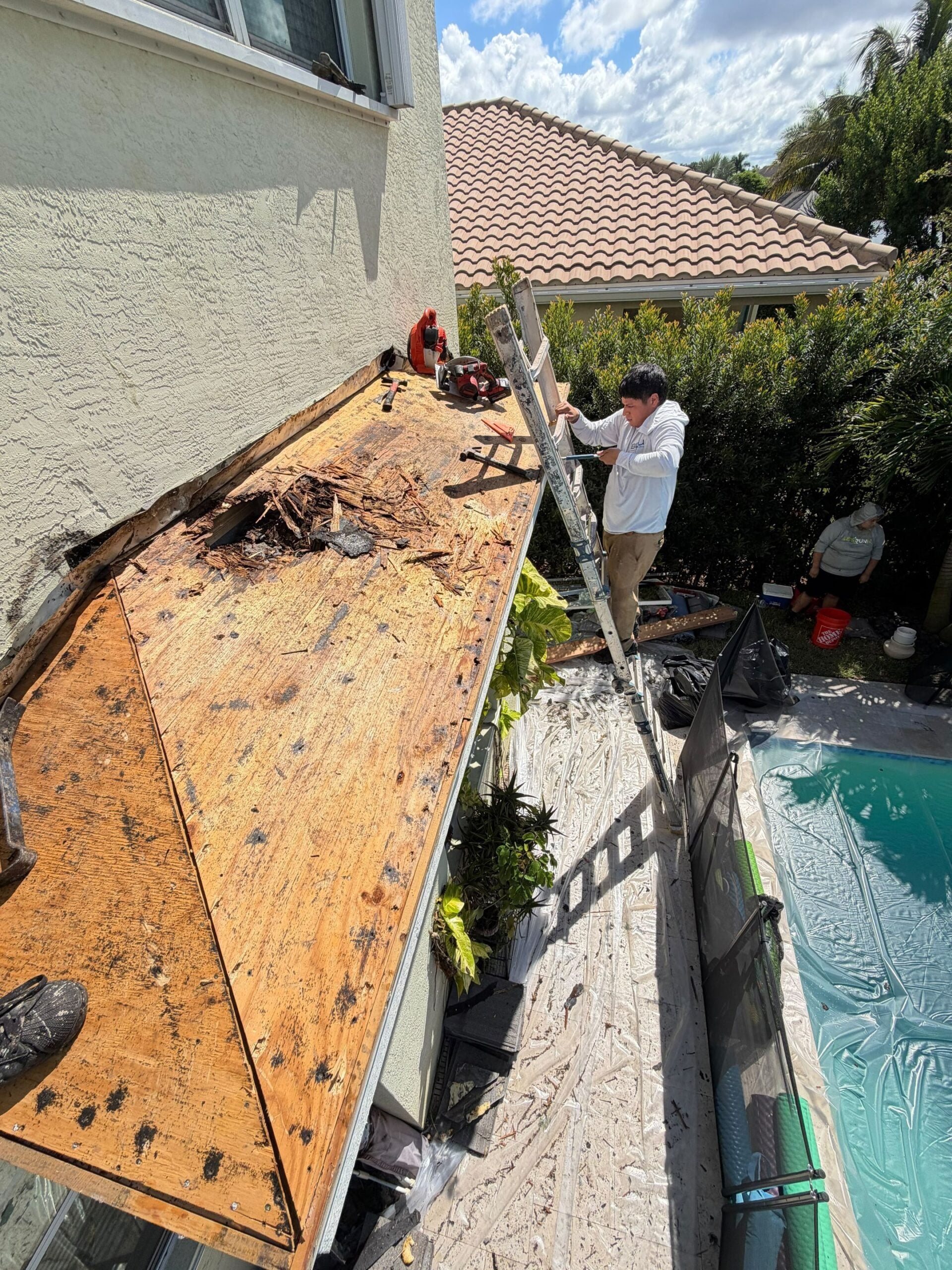
Attic inspection during the Andalucia Lake Worth roof leak repair. Finding moisture near a pipe established the general location, but controlled testing was still needed to prove exactly where the water entered.
There were several possible explanations. Water could have been entering around the roof penetration. The vent pipe itself could have been leaking. A 90-degree elbow fitting inside the attic could have been compromised. Or there could have been another small defect nearby. Each possibility needed to be tested, rather than repaired on assumption.
Controlled Testing, One Possibility at a Time
Once we narrowed the general area, we used a controlled hose test to eliminate each possible source individually. This is a straightforward method, but it needs to be performed patiently. Applying water broadly over a large area can make it difficult to know which detail is actually leaking. The point is to isolate one component at a time while someone checks the attic for water.
First, we hose-tested the roof penetration and the surrounding roof area. We checked from inside the attic, and nothing showed up. Next, we ran water through the vent pipe itself to rule out a leak in the pipe or its 90-degree elbow fitting. We went back into the attic, and again found no water. At that stage, we had enough evidence to rule out the primary penetration and the vent pipe as the source.

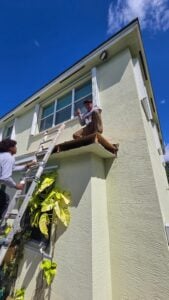
A controlled hose test on the concrete tile roof in Andalucia. Testing each detail separately helped BLU Roofing rule out the suspected dryer vent and identify the actual water entry point.
These steps were not wasted time. They were the work. A small amount of sealant may ultimately be all a repair needs, but the skill and value lie in proving what needs to be sealed, and just as importantly, what does not.
The Actual Source: A Small Gap at the Lead Pipe Boot
With the main penetration and the vent pipe ruled out, we returned to the roof and examined the lead pipe boot more closely. Lead boots are designed to conform around a pipe penetration, but a tiny gap at the lip can become a path for water under the right conditions, especially during wind-driven South Florida rain.
We noticed a very small opening at the lip of the lead pipe boot. Rather than treating it as a theory, we concentrated water directly on that exact point for an extended period. Back in the attic, we finally reproduced the leak. A small amount of water began dripping down the outside of the pipe. We had found the actual source of the ceiling stain.
That result explains why the dryer-vent repair would not have been the right first move. The dryer vent was not the problem based on the interior evidence and the controlled tests. The leak was coming from a distinct penetration roughly five feet away.
Why Roof Leak Diagnosis Matters More Than Guessing
Roof leaks are rarely as simple as they appear from the ceiling below. The location of a water stain can be displaced from the actual entry point, especially on a two-story tile roof with framing, penetrations, and attic space that allow water to travel. That is why a visual roof check alone can be misleading.
For difficult leaks, BLU Roofing combines the following information before recommending a repair:
- The precise location of the interior ceiling stain.
- Attic conditions, including moisture, water marks, and the direction water is traveling.
- Exterior roof conditions around every relevant penetration and flashing detail.
- Controlled hose testing, when the source cannot be proven through inspection alone.
The objective is not to identify something that might be leaking. The objective is to reproduce the leak and prove exactly where the water is getting in before repairing it. That approach prevents unnecessary work, protects the homeowner’s budget, and gives the repair a much higher chance of lasting.
It is also why a second opinion can make sense when a diagnosis or estimate does not add up. The lowest quote is not automatically the right answer, and neither is the highest. The right answer starts with knowing what actually needs to be fixed.
The Repair and the Result
Once we isolated the exact source, the repair itself was simple. We allowed the lead pipe boot to dry, then properly sealed the small opening at the lip. There was no need to replace the entire pipe boot, repair the dryer-vent area, or start replacing unrelated roof details because those components had been tested and ruled out.
The inspection and repair were completed the same day. The service call and repair total was $500. The value was not the small amount of sealant used at the end. The value was the diagnostic work involved: multiple trips onto a two-story tile roof, attic access, a 40-foot ladder, controlled water testing, and the experience to eliminate each possible source without jumping to the most expensive repair.
More than a month and a half after the repair, the homeowner had experienced plenty of South Florida rain without any further leaking. That follow-up period provided an additional layer of confirmation that the correct source had been identified and repaired.
If you have a ceiling stain, a recurring tile roof leak, or an estimate that does not fully explain the cause, contact Peter Menke at 561-379-5364 for a detailed inspection. BLU Roofing serves Lake Worth, Wellington, Palm Beach Gardens, and Palm Beach County with leak diagnosis and repairs designed to be wind resistant and water-tight.
Written By: Peter Menke
Peter Menke is the owner of BLU Roofing and has been serving the South Florida roofing industry for over 6 years. He founded BLU Roofing to provide homeowners with transparent, accurate data grounded in the reality of Florida’s unique climate and building codes, information that is often missing from generic national roofing advice. License #CCC1337285